
California Photo Rules When a Friend or Relative Serves Papers
Elvis
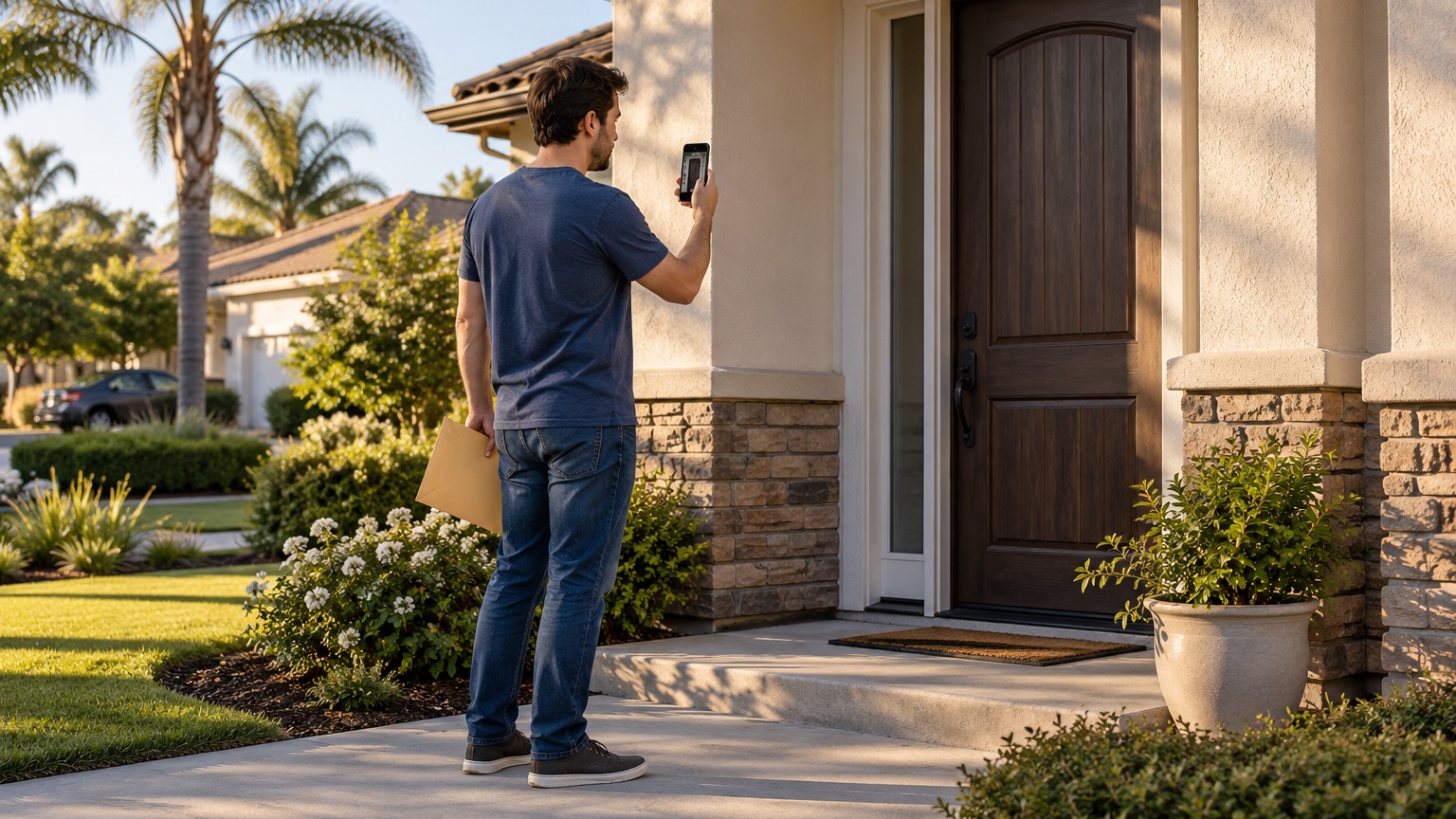
If you are serving your own California case papers through an adult friend or relative, the new photo rule can apply to you. Starting January 1, 2027, Code of Civil Procedure section 417.10 requires stamped photos for personal service, substituted service, and unlawful detainer posting and mailing.
This is not only a rule for registered process servers. An adult friend who is not a party to your divorce case can serve papers, and that person may need to take and attach the required photo. California's self-help guidance on serving divorce papers still explains who may serve in family law cases.
Status as of October 2026: The updated forms discussed below were on the agenda of the Judicial Council meeting on October 16, 2026, with a proposed effective date of January 1, 2027. The item numbers in this guide follow the recommended versions, so check the final forms on courts.ca.gov before you file. See the meeting agenda, the civil forms report, and the family law forms report.
Who needs to take a service photo?
The rule applies to the person who actually serves the papers. That can include a registered process server, sheriff or marshal, or a person who is not a registered California process server.
For family law, including divorce, parentage, and custody cases, the server must generally be at least 18 years old and not a party in the case. So if you ask an adult friend or relative to deliver divorce papers, that friend may be the person responsible for the photo and the proof of service.
The requirement covers these methods:
- Personal service under Code of Civil Procedure section 415.10.
- Substituted service under section 415.20.
- Unlawful detainer posting and mailing under section 415.45.
Two important exceptions:
- Small claims is not covered. Do not assume that a small claims proof of service needs a stamped photo because of this law.
- Restraining-order type proofs of service are not required to include photos. The proposed rules exclude these matters because of safety concerns.
The rule comes from AB 747. If you serve papers for a living, see our separate guide for registered process servers.
What the photo must show
For a completed personal or substituted service, the photo is of the location where service happened. The person served does not need to be in the image. Neither does the server, a neighbor, or anyone else.
A compliant photo should:
- Be taken as close as practical to the time of service.
- Have a readable stamp that automatically records the date and time.
- Have readable GPS coordinates, or equivalent coordinates, automatically recorded with the photo.
- Show the door at a residence or business when reasonably accessible.
- Show the building entrance if the door is not reasonably accessible, along with an explanation on the form.
- Show the specific office entrance when service is at a business office, where applicable.
If service happens somewhere that is not a residence or business, such as a parking lot, the door or entrance requirement does not apply.
The law does not define exactly what counts as a “readable stamp.” The Judicial Council noted that the wording is ambiguous and left that question to judges. Our practical reading is to use a visible stamp burned into the image at capture, not text added later, and keep the original photo file as well. Adding date, time, or location text after taking the photo does not appear to fit the requirement that the information be automatically recorded.
There is no form box that says, “My camera cannot stamp photos.”
Completed service photos versus unsuccessful attempts
This distinction matters if you are trying to use substituted service.
Your proof of service photo documents the completed service location. But if personal service fails and you rely on substituted service, photos of the unsuccessful attempts go in a declaration of diligence.
Beginning in 2027, reasonable diligence for substituted service means attempts at personal delivery on at least:
- Three different occasions.
- Three different days.
- Three different times.
For example, a friend serving divorce papers might try Tuesday morning, Thursday afternoon, and Saturday evening. If the person cannot be personally served, the server needs to document the attempts before using substituted service. Each attempt should have its own photo attachment in the applicable declaration of diligence.
Family law forms: FL-115 and FL-116
If you are looking up how to serve divorce papers in California in 2027, these are the main form changes to know.
FL-115, Proof of Service of Summons
FL-115 is used in family law cases, including divorce. The recommended 2027 version adds photo sections for the methods that trigger the rule:
- Item 3b: Photo requirements for personal service. Attach a photo of where the papers were served, unless taking it would risk the server's safety.
- Item 4d: Photo requirements for substituted service. The photo shows where the papers were left.
- Item 4e: Declaration of diligence. Use FL-116 or an equivalent declaration to explain the unsuccessful personal-service attempts.
FL-115 items 5 and 6 do not have a photo item:
- Item 5: Service by mail with notice and acknowledgment of receipt.
- Item 6: Certified or registered mail to an address outside California.
The form also identifies a server who is “not a registered California process server.” That is a clear sign that the FL-115 photo requirement is not limited to professionals.
FL-116, Declaration of Diligence for Substituted Service of Summons
FL-116 is a new optional family law form for documenting diligence before substituted service.
- Item 2: List the personal-service attempts, including date, time, and address.
- Item 3: Attach a photo for each attempt. The attachments are listed as 3a, 3b, 3c, and so on.
Each attempt photo follows the same basics: automatic date, time, and GPS or equivalent coordinates; a door or entrance photo where required; and an explanation if there was no signal or a safety reason prevented a photo.
Civil forms: POS-010 and POS-012
Self-represented parties in general civil cases will usually see the changes on these forms.
POS-010, Proof of Service of Summons
The revised POS-010 adds item 8, “Photo of the location of service.” It applies when the server checks:
- Item 5a: Personal service.
- Item 5b: Substituted service.
- Item 5e: Unlawful detainer posting and mailing.
In item 8, the server attaches the photo on a separate page labeled Attachment 8. The server identifies whether the photo has the required automatically recorded stamp or explains why there is no readable GPS stamp because there was no signal.
The server also indicates whether the location was a residence or business. If it was, the photo should show the door, or show the entrance and explain why the door was not accessible. The item also includes a safety option when taking a photo would compromise safety.
POS-012, Declaration of Diligence, Service of Summons
POS-012 is a new optional form that can support substituted service or a request for unlawful detainer posting and mailing.
- Items 3, 4, and 5: Record the first, second, and third personal-service attempts.
- Items 3c, 4c, and 5c: Attach a photo for each respective attempt, labeled Attachment 3c, Attachment 4c, or Attachment 5c.
- Item 6: In unlawful detainer matters, documents locations where substituted service was attempted.
Each person who made an attempt should complete their own POS-012. Do not have one person sign for attempts another person made.
Step by step: serving divorce papers through a friend in 2027
Here is a practical workflow when an adult friend agrees to serve your divorce papers.
- Choose an eligible server. Your friend or relative must be at least 18 and cannot be a party in your case.
- Give the server the correct papers. Make sure they know the person to be served and the correct address. The server, not you, should complete the proof of service based on what actually happened.
- Try personal service. The friend personally delivers the papers to the other party.
- Take the completed-service photo. As close as practical to delivery, the server photographs the service location. At a home, photograph the door if reasonably accessible. At a business, photograph the business door or relevant office entrance.
- Complete FL-115 item 3 and item 3b. Attach the stamped photo as instructed by the current form.
- If personal service fails, make three documented attempts. The attempts must occur on three different days and at three different times. For each attempt, record the date, time, address, and what happened. Take a stamped location photo for each attempt.
- Use FL-116 if substituted service is needed. Attach the attempt photos to the declaration of diligence. Then complete FL-115 item 4, including the required mailing and the substituted-service photo section.
- File the proof and attachments. Keep copies of everything, including the original photo files.
Substituted service has other legal requirements beyond the photo rule. Read the current court instructions and forms before relying on it.
Taking a stamped service photo with Timemark
A timestamp GPS photo app for proof of service can make the capture step easier. Timemark is a free iPhone and Android camera app that prints the date, time, address, GPS coordinates, and an optional note directly on the image at the moment of capture. Its time comes from the network, rather than the phone clock.
- Download Timemark before the service attempt.
- Open the app at the service location.
- Frame the required door or entrance, if the location is a home or business.
- Take the photo as close as practical to the service or attempt.
- Check that the visible stamp is readable before leaving.
- Keep the original image and attach a copy to the required form attachment.
Timemark cannot add its stamp to an old photo or change the recorded time. Photos can be taken with a weak signal and sync later. A photo also has a Photo Code that can be checked at Timemark Photo Verification.
No particular app is required by the Judicial Council. Timemark is not court-approved and cannot guarantee that a court will accept any proof of service.
What if there is no signal or taking a photo is unsafe?
No signal
If there is no readable GPS stamp because there was no signal, the forms provide a place for a detailed explanation. Explain why there was no signal and why GPS could not be recorded. Do not treat a phone with an unsupported camera or a forgotten setting as the same thing as no signal.
Take the photo as close as practical to service anyway, if it is safe. Preserve what the device recorded and write the explanation carefully on the form.
Safety concern
Do not take the photo if, in the server's reasonable judgment, doing so would compromise safety. The statute allows this exception, but the server must provide a detailed statement explaining the safety reason instead.
For example, a server should not remain at a hostile location just to photograph a door. Safety comes first.
FAQ
Can a friend serve divorce papers in California and take the photo?
Yes. An adult friend or relative who is not a party in the case can generally serve divorce papers. If the method is personal or substituted service, that friend may need to take and attach the required stamped photo.
Does every California proof of service need a photo in 2027?
No. The rule applies to personal service, substituted service, and unlawful detainer posting and mailing. It does not apply to small claims, and restraining-order type proofs of service are not required to include photos.
Does the person being served need to appear in the photo?
No. The photo documents the location. The server, the person served, and other people do not need to appear.
What is the FL-115 photo requirement?
For personal service, use FL-115 item 3b. For substituted service, use item 4d. Attach the location photo with an automatically recorded date, time, and GPS or equivalent coordinate stamp, unless a no-signal or safety explanation applies.
What is the FL-116 declaration of diligence?
It is a family law form for documenting unsuccessful personal-service attempts before substituted service. It includes a photo requirement for each attempt and supports the three-attempts-on-different-days-and-times rule.
What does POS-010 item 8 require?
POS-010 item 8 requires an Attachment 8 photo for completed personal service, substituted service, or unlawful detainer posting and mailing. The attachment addresses the stamp, GPS, door or entrance, no-signal explanation, and safety exception.
Can I add a timestamp and GPS text after taking the picture?
That is risky. The statute calls for information automatically recorded when the photo is taken. The term “readable stamp” is not fully defined, but adding text later does not appear to satisfy that wording.
General information, not legal advice; check the current forms on courts.ca.gov.